Sunday, 17 July 2011

One more night...

a snack of fried chilis for the walk


The last night in Thanjavur has fallen upon 14 TPS students scrambling...err, gracefully and knowledgeably putting together their implementation and evaluation plans for their respective interventions. So, busy busy we are...

Luckily Audra and a few of our ICTPH colleagues, Subha, Deepak and Arun, caught a break yesterday and visited Kallanai. About an hour away, it's home to a pretty impressive dam built by a Chola king around the first century--one of the oldest operational infrastructure pieces in the world. The dam itself is a long walk, surrounded by lovely lush greens, sands, and...you guessed it, water. Enjoying the breeze and hearing the waves and rapids running through the locks was incredibly peaceful. And perhaps the most cool AND quiet I've experienced since being in Thanjavur. A nice time to reflect on all the city has offered to us and how that experience will inform the next steps...

Tuesday, 12 July 2011

Spirituality, satyagraha and space ships


The actual traveling part of traveling was a fun was to see lots and lots last weekend. The standard bus to Madurai served Leslie, Shawn and myself well. We paid rs 50 each way (about $1) to travel the 4 hours from Thanjavur. Although it was a tight squeeze and there was no AC, the constant cross breeze made for a comfy ride. What was really exciting was being part of the hustle of all the bus stations we passed through. So many travelers, vendors yelling about their jackfruit, pineapple, samosas and random gadgets, and vehicles flying in and out of the crowded parking lots.

A bit about our destination city:

Madurai is the second largest city in the state of Tamil Nadu and one of the oldest continuously occupied cities in the world. It's known as the cultural hub of the area, both historically and presently. Historically, it was described by various royal visitors as the most beautiful city they had seen. Today it's know for the Sri Meenakshi Temple, Gandhi Museum, various textile artisans and jewelers.

So, a big tourist spot. We saw so many white people!! The urban feeling in Madurai was nice, even if a bit bland, apart from the touristy stuff. I mean, it was great to be in an urban area. Alas, I am a city girl. Even though it was a relatively small urban/unremarkable area by Indian standards (2 million people). Makes me really want to fit some time in Bangalore into my upcoming travel itinerary...

So...the things we did. The Sri Meenakshi Temple was a sight to see. What really struck me though was the way in which I felt gaudy and touristy, and still spiritual at the same time. The outside of the temple is full of vendors shouting at you to buy their goods. The inside of temple was equally full of noise and bustle. Perfect example of how nothing in India is quiet. Ever. It was a new experience to feel spiritual in the midst of all of the people chanting, making their way from one god's station to another, lighting candles and incense, bowing, singing...I even was able to meditate for quite a while in the meditation hall. So wonderfully refreshing.

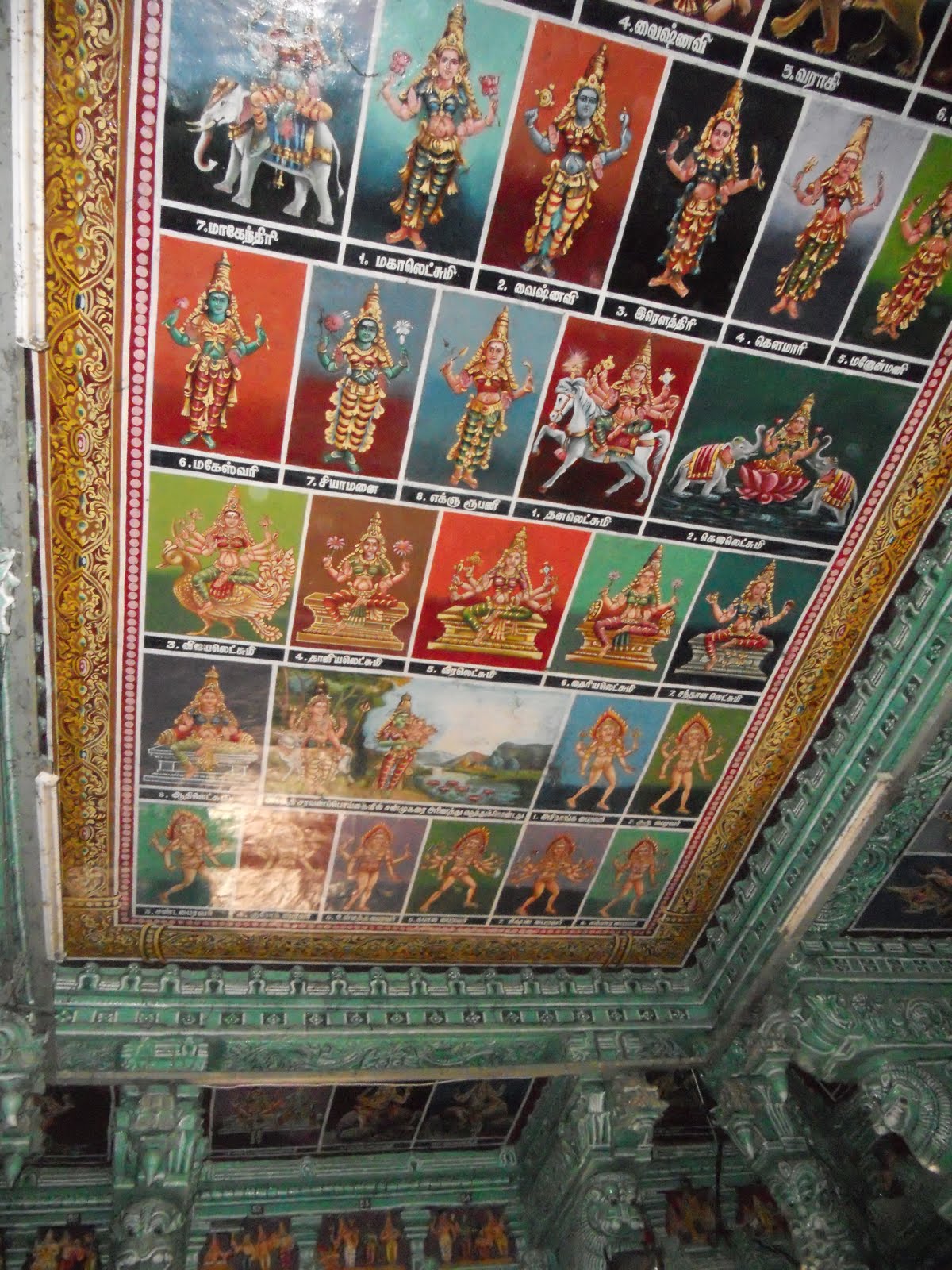
A bit on the history of the temple, too. It's dedicated to Meenakshi, who is the wife of Shiva. Shiva is one of the three central gods in Hinduism, Brahma and Vishnu. Shiva is the destroyer, Brahma is the creator and Vishnu is the preserver. Without going into too much detail and messing up the mythology, the basics are that Meenakshi was born to a king, who was unable to have a child, as an avatar of the Hindu goddess Pavarti. She was born with three breasts, and the king was told that when she met her true love, her third breast would fall off. And so it did when she met Shiva. These stories are depicted in much detail throughout the temple in paintings and stone carvings. One carving that represents the marriage is a popular place for couples to stop during their marriage ceremonies (of which we saw many). Overall, the attention to balance in all of these mythological stories has been really fascinating to me. Seems so deliberate, and yet doesn't always play out in day-to-day life (I'm thinking specifically of some of the gender roles I've observed), which is the same for any religion in any place. Or any philosophy in any discipline...oh the disconnects between theory and practice.

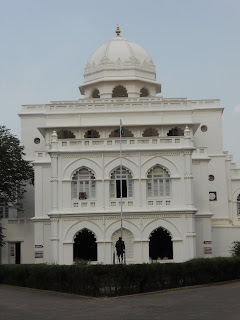
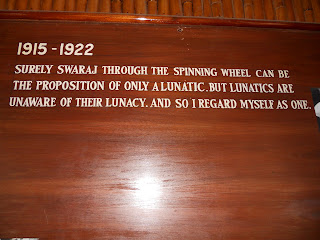
After the temple we visited the site I was most excited about, the Gandhi Museum. Having been a peace studies major in undergrad, Gandhi's teachings and methods have really inspired my path. And wow. To see Gandhi's story, written so honestly, and in English (wah wah), was a really emotional experience for me. I'm not sure how to describe it. I keep imagining what was going through Marin Luther King Jr's mind as he visited this place. Surely so many more intelligent things than I could ever say here. However, the bottom line is that satyagraha, the philosophy of eliminating oppression through transforming the relationship between the oppressor and the oppressed, is pretty amazing. Go figure, resisting the actions of the oppressor, without resisting the actual oppressor...just what if we all were committed to employing such sole force, with the really big picture in mind...in what ways would that manifest itself? Not just in the grand scale of fighting oppressive regimes, but in everyday life too...living simply and modestly, honoring the dignity of living things and the earth, recognizing our own limitations and seeking ways to grow as individuals and in community...

And to make the most bizarre transition from that...we also visited Apollo 96, a spaceship bar. Yes, a bar made to look like a spaceship. In India. A fitting was to process the the idiosyncrasies of the days events...

Thursday, 7 July 2011

Working, eating, being

paneer dosai
fresh squeezed pineapple juice
cleaning the water tank--

the panchayat's husband getting a sample of water from the tank for us to test
temple festival
happy birthday, Ramesh!

Basically sums up the last week.

Working:

The intervention is designed! It includes two components: 1) installing water filtration devices on all (hopefully) of the public water collection taps in Ambalapattu, and 2) administering an ORS education campaign to mothers with children under five.

Now we're working on designing how the intervention will be implemented and evaluated. The village panchayat (mayor) has agreed to help with implementing the water filter component, including installing and maintaining the filters and assisting with an awareness campaign about the filters. Which works nicely: we get the community's help/buy-in, she gets political points and residents get clean water.

Still, this implementation and evaluation portion of designing an intervention is tough. One, I have zero background in this, as I haven't taken this course yet. Thanks to my team members for coaching me through this! And two, there are lots and lots of ways to implement and evaluate. It's sort of a crapshoot to choose one method and justify it. Last, there are several obstacles, plain and simple. As for the obstacles, the panchayat brought up several important points we have already been working through:
  • what if we can't afford to put filters on all taps--who would get the filters then...and is that even ethical to only install some filters?
  • how do we cultivate community by-in for the water filters?
  • how do we inform people about the filters so that they are comfortable with them?
  • how do we ensure the filters are properly handled by community members?
Big props to the panchayat for all of her time and feedback. It's definitely made our job exponentially easier to have her guidance and support. Certainly highlights the importance of working with stakeholders, especially on the policy level. Also how having that support makes me, as the "public health professional" feel much more confident with our plan.

We also tested the water in Ambalappatu. We collected samples from the government tank, a public tap and a storage vessel in a home. It will be interesting to see the results, especially at the tank level. I don't think I mentioned this earlier, but last week we observed a government tank cleaning. We saw the chlorine and watched the panchayat actually pour it into the tank. Erin L and Eprise got a great look by actually climbing to the top of the water tank. Brave souls.
As mentioned before, these results will be of use in determining whether an in-home intervention is also necessary. The water filters on the taps ensure that infectious agents living in the government tank or pipes are killed. But they don't help if infectious agents are getting into the water in the home storage vessels. Hopefully our hypothesis, based on our field observations, that the water is safely handled in the home will be confirmed so that an additional intervention component is not necessary...

Eating:

Dosas, dosas and pineapple juice!! Dosas are wonderful thin breads stuffed with stuff. Sort of like injeera crossed with a pancake. I'm loving the masala dosa (potato, onion, masala sauce) and paneer dosas (cheese and masala sauce) as of late.

Egg byriani was also a big hit this week. A few of us checked out a local place that came highly recommended, and we were not disappointed. I was especially excited since most byriani is non-veg, and Tevars had egg along with the meat choices. Of course we ended up at Arun ice cream after. Mango and chocolate was a brilliant idea, if I do say so my self.

It was also Ramesh's birthday today and Ravi organized a nice surprise breakfast for him, complete with an awesome cake. So yummy.

Being:

So one of the things I've been struggling with since being here is balancing work and experiencing the everyday life. It seems that, when I really want to do some good research and writing, I end up holing myself up in the AC office with florescent lighting and bottled water. Which is not the everyday experience here...

I had a nice break last night when I decided to walk away from the Google doc and join Sonia and Dessa for a walk around the big temple. We took the bus (which always makes me happy, and I don't know why I don't do it more. fail.) and were excited to see that the temple was all lit up and had live music. It was refreshing to just sit and people watch--the lights, the little kids dancing, the men clapping to the music. Not to mention in front of an incredible ancient structure. There's a video attached.

I need to be more deliberate in taking time to be. And be as they be in India. Feels good.

Hopefully this weekend will offer that opportunity. Maduari is on tap. A few of us are venturing on the standard bus to the cultural capital of southern India. It is known around the world for the ancient temples and market places. And the Ghandi museum. Dr. Martin Luther King Jr was said to have been inspired here, and, as a peace studies major, I am really excited to experience it myself. More updates to come this weekend...


Monday, 4 July 2011

4th of July, India style


Hope yous guys at home are enjoying some grilled corn, watermelon, veggie burgers, etc.

Sonia and I perused a few markets and pulled together some Pringles, sour cream and onion Lays, Oreos and Coke. And, some veggies and spices for some guac, make by Leslie, who, I must say, is a guac expert. Also, with Ravi's help, we has some fireworks too! It was quite the show; all of us students and ICTPH staffers were definitely impressed.

As much as it's been exciting to attempt to try to do all things Indian, enjoying some comforts from home was really nice. Also sort of fun: reflecting on how the opportunities I've had, as a result of my nationality, enable me to do some really cool stuff. Like come here. And how maybe, hopefully, this will help me to be a part of a larger effort to help make opportunities accessible to people from St. Louis to Thanjavur...you know, social justice, and all that social work-y stuff :)

Sunday, 3 July 2011

A six banana hike

wooooow

warming up with some (really good) red wine


up the tree root steps we go
terraced hills with the pretty little cottages


Day two in Kodai started off with another hike on the Dolphin's Nose trail. Compared to the trail on Friday, it was far more crowded, and well, more worn. The trail wound through a little town dotted with vendors along the way. Which was nice because I bought and ate six perfect bananas en route (the bananas here are sold really ripe...so I was pumped to have some greenish ones. So pumped, I had six, I guess. India sized bananas though. Still an accomplishment that no monkeys stole them...they were sneaking around all over the place).

More importantly, the trail ended with another stunning view. It was also a sunny day, so the views were super clear. A different tone from the dark mist yesterday...probably more fitting for the feel of this more popular trek.

We broke for lunch at the Hotel Punjab...really really good North Indian food. I had the special Punjabi Paneer Kadai with vegetable stuffed bread, kulcha. So good. And spicy--mouth was definitely on fire, but it was totally worth it.

After exploring the town for a while (check out the whole fish on display), a few of us found our way down to the lake to enjoy the sunset from the patio of one the snazzy hotels in town. It was interesting to watch the other tourists and how they were spending their vacations. I mean no differently from how I did growing up--seeing, shopping, eating. At nice places. Also made me think about who was vacationing in Kodai. Surprise, surprise, these folks seemed pretty upper class. And even if this place is the Vail of Southern India, the disparities between Vail and Kodai are, again not surprisingly, super obvious.

For example, like most of India and like most developing countries, the infrastructure to maintain a trash collection system is just not there. So at least a few of these trails have lots of trash on them. Which brings up some questions for me about where public works priorities should be and who decides those priorities. Like is it similar to the US where a huge campaign about protecting nature and "taking only pictures and leaving only footprints" was effective (of course paired with a system that had the needed infrastructure)? And is it like the Beyond Housing idea where if you made neighborhoods aesthetically pleasing it has profound effects on the collective mood of the neighborhood. And, in turn that encourages people to do even more to maintain and upgrade, as possible? Related to all this, how do you take advantage of the extra tax revenue generated from all this tourism? Seems like it was going to good use in that all the roads were in pretty good shape...but who makes those decisions? So there is my privileged self musing about disparities, on a fancy patio drinking expensive wine...eh?

On an unrelated note, AVOCADO has made its way back into my life. Definitely an important moment. They're a different type than in the US, so I didn't recognize them at first. They are AMAZING. And now they I know what they look like and are called (butter fruit) I can hopefully find some back in Thanjavur. In the meantime I'll enjoy this one with some chili chips. MMMMMM.

Friday, 1 July 2011

Dizzying heights


Kodaikanal, India. A hill station in the Ghats Mountains. Breathtaking.

Not sure how to really describe the views from this mornings hike. First, following waterfalls. Then. The valley, mist swirling, was stunning...surrounded by the blue mountain shadows, lush with green and dotted with quaint cottages. So peaceful So errie. So incredibly beautiful.

And chocolate. Homemade chocolate is a specialty of Kodai and was absolutely consumed from a precarious (although safe, Mom) perch on the mountainside...watching the mist settle in, listening to the waterfalls below and the rumble of the approaching thunderstorm...

Also, you might notice from the pictures, it's COLD here. Pants, t-shirt, sweater and raincoat cold. See your breath in the rain cold. So cold, there are hot showers. And hot tea in the afternoon. Mmmmm mountains...